
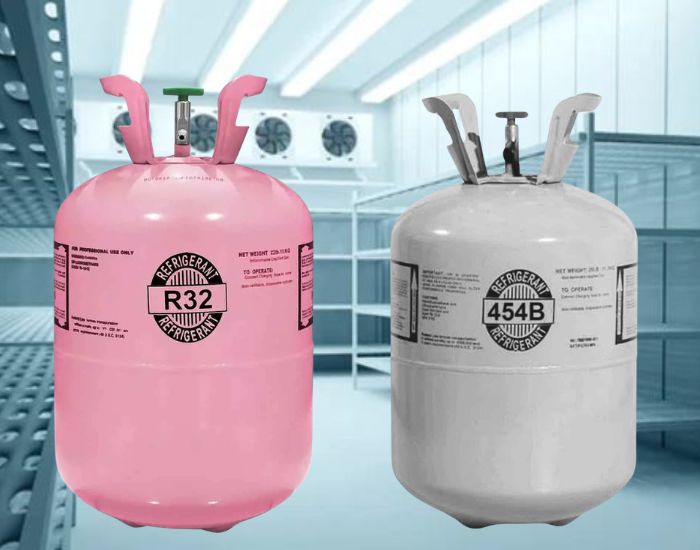
Are you an air conditioner manufacturer looking for a refrigerant with a lower environmental impact? Usually, R32 and R454B are two amazing options. Both offer lower GWP, but are they the same? Obviously not.
Some manufacturers prefer R32 because of its strong cooling performance and simple composition. Others choose R454B because it offers a lower GWP and helps meet future environmental requirements.
Let’s have a look at R32 vs. R454B to understand where each refrigerant stands in 2026.
What Is R32 Refrigerant?
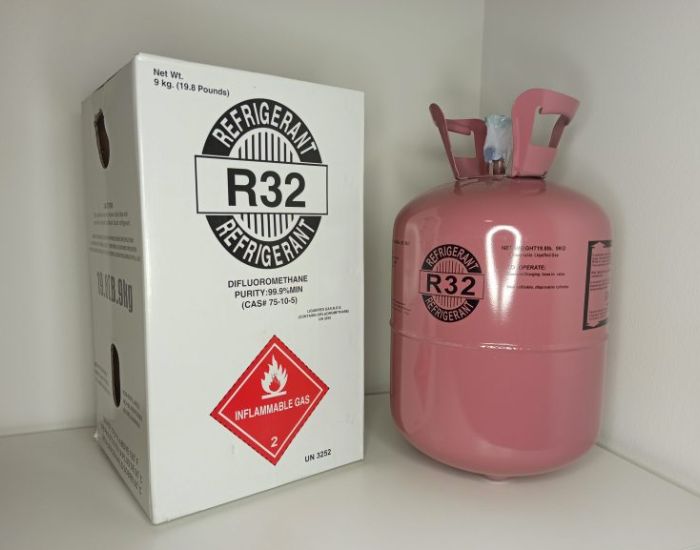
R32 refrigerant is best for residential and light commercial air conditioning systems. Many manufacturers use R32 in split systems, heat pumps, and residential cooling applications.This refrigerant is a single-component HFC refrigerant and consumes less electricity. R32 replaced R410A with lower GWP.
Moreover, R32 is classified as an A2L refrigerant, meaning it has low toxicity and mild flammability. Furthermore, it is a pure refrigerant. This makes it easier to recover, recycle, and recharge during maintenance.
Key Features of R32 Refrigerant
- Single-component refrigerant
- Lower GWP than R410A
- High energy efficiency
- Strong cooling capacity
- Easier to recover and recycle than blended refrigerants
- A2L safety classification (low toxicity, mildly flammable)
- Commonly used in residential and light commercial air conditioners
What Is R454B Refrigerant?
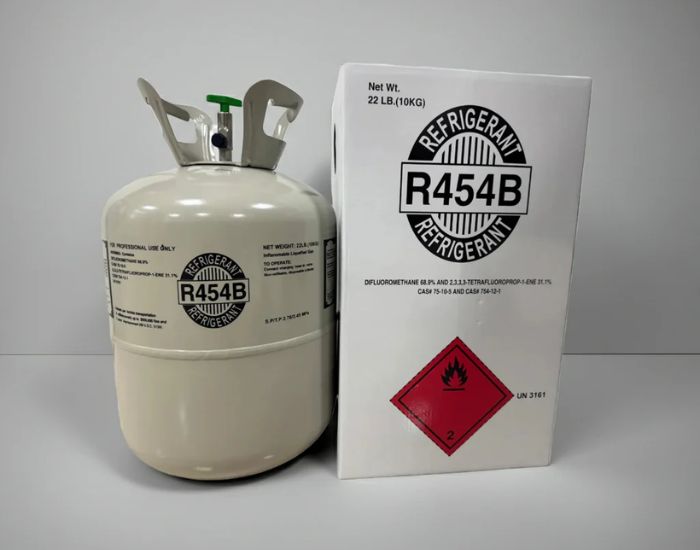
R454B is used in modern heat pumps and air conditioners. Manufacturers are choosing it as an alternative to R410A because it has a lower environmental impact.
It is a blended refrigerant designed to reduce global warming potential. This helps HVAC systems comply with future environmental regulations.
It is also classified as A2L. It has low toxicity and is mildly flammable, so proper safety practices are needed during installation and maintenance.
Key Features of R454B
- Lower GWP than R410A
- Blended refrigerant composition
- Used in new-generation HVAC systems
- A2L safety classification (low toxicity, mildly flammable)
- Helps meet future environmental regulations
- Designed for long-term use in modern air conditioners
Similarities Between R32 and R454B
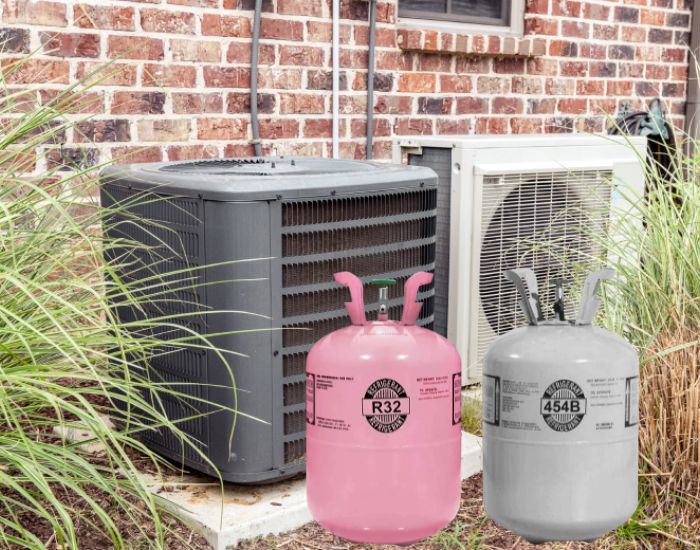
R32 and R454B are both modern refrigerants used in today’s air conditioners and heat pump systems. They were developed as alternatives to older refrigerants like R410A, mainly to reduce environmental impact.
Both options are widely adopted by HVAC manufacturers because they help meet stricter climate regulations while still delivering good cooling performance.
Key Similarities
- Both are used in modern residential and commercial HVAC systems
- Both replaced older high-GWP refrigerants like R410A
- Both have lower global warming potential compared to older options
- Both are classified as A2L refrigerants (low toxicity, mildly flammable)
- Both require proper safety handling during installation and servicing
- Both are designed for improved energy efficiency in air conditioners
- Both are supported by major HVAC manufacturers worldwide
In simple terms, R32 and R454B are very similar in purpose. They are both part of the shift toward more environmentally friendly cooling technologies.
Differences Between R32 and R454B
R32 and R454B are built differently and perform in slightly different ways. These differences are mainly due to their composition, environmental impact and behaviour of the system.
R32 is a single component refrigerant. This makes it easier to handle during installation and maintenance. It also has good cooling performance and is already widely used in many air conditioning systems.
R454B, on the other hand, is a mixture of refrigerants. It is designed with a lower global warming potential and therefore is more in line with future environmental regulations. But its blended nature means it needs more careful handling than R32.
System design and servicing are different too. R32 systems tend to be easier to service because the refrigerant is the same. R454B requires more attention during maintenance because of the composition of the mixture.
Here’s a side by side comparison for better clarity.
| Feature | R32 | R454B |
| Type | Single-component refrigerant | Blended refrigerant |
| Composition | Pure refrigerant | Mixture of refrigerants |
| Global Warming Potential (GWP) | 675 vs 466 | Lower than R32 |
| Handling | Easier to handle and service | Requires more careful handling |
| System Design | Widely compatible and established | Designed for newer system requirements |
| Servicing | Simple recovery and recharge | More sensitive during maintenance |
| Market Adoption | Already widely used | Growing in newer HVAC systems |
| Focus | Strong performance and efficiency | Lower environmental impact and future compliance |
FAQs
Which is better, R32 or R454B?
Both have their strengths. R32 is widely used and offers strong cooling performance with easy servicing. R454B has a lower global warming potential and is better aligned with future environmental regulations.
Is R454B safer than R32?
Both refrigerants are classified as A2L, meaning they have low toxicity and mild flammability. Their safety level is similar when used in properly designed systems.
Can R454B replace R32?
Not directly. R454B is used in specific systems designed for it. It is not a simple drop-in replacement for R32.
Why is R32 more popular?
R32 is already widely adopted, easier to handle, and offers strong energy efficiency. Many existing HVAC systems are designed around it.
Which is better for future use?
R454B is often seen as more future-focused because it aligns better with upcoming environmental regulations, while R32 is already well established in the market.
Conclusion
Both refrigerants are solid choices. It just depends on what you value more.
Go with R32 if you want proven cooling power, easier servicing, and wide technician support today. It’s already everywhere in residential ACs and heat pumps, and technicians know it inside out.
Go with R454B if you’re thinking long-term. Lower GWP means it’s more aligned with future environmental regulations.
In short:
- R32 wins on “here and now” — performance + simplicity.
- R454B wins on “tomorrow” — lower GWP + future-proofing.
You may also find this blog post useful:
What is a refrigerant? The ultimate guide.
Types of Refrigerants: The Complete Guide
Which gas is used in air conditioners?
About The Author

Evan Wang
I am Evan Wang, the General Manager, Marketing Director, and SEO Expert at Sunnyda Cold Room. I have over 20 years of experience in the refrigeration industry, and my expertise is in commercial refrigeration solutions.
I’d be delighted to share practical ideas about refrigeration products, project selection, export trade, SEO, and marketing.
Let’s connect!

