
If your AC system still uses R22 refrigerant, you’re not alone. But you should know: it’s being phased out, and costs are rising fast. In this guide, you’ll learn what R22 refrigerant is, where it’s still used, and which refrigerants can replace R22 refrigerant.
What is R22 Refrigerant?
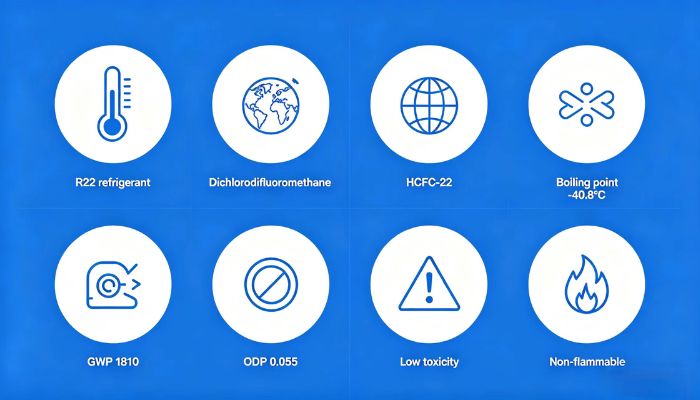
R22 refrigerant, chemically known as dichlorodifluoromethane (CHClF2), is part of the HCFC refrigerant family. At room temperature, it is a colorless, nearly odorless gas. It’s non-flammable, non-corrosive, and has low toxicity. It turns into liquid under pressure, which makes it easy to store and transport. As a medium-temperature, medium-pressure refrigerant, it works efficiently in most cooling systems. It was widely used in AC systems, cold storage, and refrigeration equipment.

Characteristics of R22 Refrigerant
Physical Properties
R22 has a low boiling point, allowing it to evaporate and absorb heat at relatively low temperatures. Its high critical temperature enables it to be liquefied by compression at room temperature. Its density makes it easy to move through piping systems. It is classified as A1, meaning it is a non-toxic, non-flammable refrigerant.
R22 has an Ozone Depletion Potential (ODP) of 0.055 and a Global Warming Potential (GWP) of 1,810. Although these values are lower than those of earlier refrigerants such as R12 (ODP = 1), they still have a significant impact on the ozone layer and the climate.
Because of this, many countries have restricted or banned its use. That’s why R22 is being phased out worldwide. In the U.S., R22 has already been phased out, and only recycled supplies are still available.
You can find more information about R22 refrigerant in the table below:
| Property | R22 refrigerant |
| Composition | HCFC-22 |
| Chemical Name | Difluorochloromethane |
| Chemical Formula | CHClF2 |
| Global warming potential (GWP) | 1810 |
| Ozone depletion potential (ODP) | 0.055 |
| Boiling point | −40.7 °C (−41.3 °F) |
| Melting point | −175.42 °C (−283.76 °F) |
| Density (ρ) at 15 °C (gas) | 3.66 kg/m3 |
| Specific volume (ν) at 21 °C (gas) | 0.275 m3/kg |
| Density (ρ) at 15 °C (gas) | 3.66 kg/m3 |
| Triple point temperature (Tt) | −157.39 °C |
| Critical temperature (Tc) | 96.2 °C |
| Critical pressure (pc) | 4980kPa |
| Vapor pressure at 21.1 °C (pc) | 0.9384 MPa |
| Critical density (ρc) | 6.1 mol/l |
| Latent heat of vaporization at the boiling point | 233.95 kJ/kg |
| Safety classification | A1 |
| Packaging sizes | steel cylinders (13.6kg, 22.7kg, 400kg, 800kg) |
Chemical Properties
R22 does not react with metals under anhydrous conditions. However, it may decompose to produce acidic substances at high temperatures or in the presence of moisture. If you let moisture get into the system, it can cause corrosion and damage.
R22 can absorb a large amount of heat, which makes it effective for cooling. Its compression ratio (the ratio of evaporation pressure to condensation pressure) is approximately 3–4, which is lower than that of refrigerants such as ammonia. It helps reduce stress on your compressor. However, R22 has a high isentropic index (1.18), which leads to higher discharge temperatures, so your system needs a proper cooling design.
Below is a reference chart showing the specific heat capacity of R22 at different temperatures:
| Temperature (K) | Density (kg/m^3) | Specific heat (kJ/kg K) |
| 230 | 1416 | 1.087 |
| 240 | 1386.6 | 1.1 |
| 250 | 1356.3 | 1.117 |
| 260 | 1324.9 | 1.137 |
| 270 | 1292.1 | 1.161 |
| 280 | 1257.9 | 1.189 |
| 290 | 1221.7 | 1.223 |
| 300 | 1183.4 | 1.265 |
| 310 | 1142.2 | 1.319 |
| 320 | 1097.4 | 1.391 |
| 330 | 1047.5 | 1.495 |
| 340 | 990.1 | 1.665 |
| 350 | 920.1 | 1.997 |
| 360 | 823.4 | 3.001 |
Why is R22 Being Phased Out?
R22 contains chlorine, which releases chlorine radicals under ultraviolet radiation, damaging the ozone layer. The ozone depletion potential (ODP) of 1 kg of R22 is equivalent to that of 0.055 kg of R11 (an early primary refrigerant). Furthermore, its global warming potential (GWP) is high. The greenhouse effect of 1 kg of R22 is equivalent to that of 1,810 kg of carbon dioxide, which has a major impact on climate change.

Regulations about R22
UN
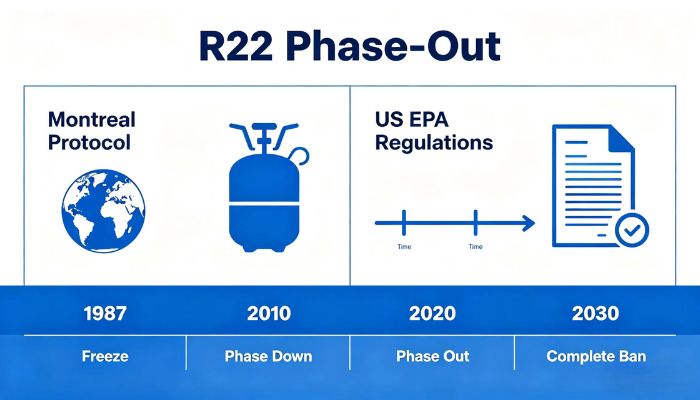
The Montreal Protocol: This is the core legal framework for the international community’s collective response to ozone layer depletion. Under the Protocol, developed countries must reduce their consumption of R22 by 99.5% by 2020. The remaining 0.5% may be used for servicing until 2030, after which its use must be completely phased out.
US
The U.S. Environmental Protection Agency (EPA): The EPA prohibits the production and import of R22 refrigerant. The U.S. has also imposed restrictions on manufacturers, prohibiting them from using R22 refrigerant to produce new refrigerants. It means that you can’t produce or import R22 anymore. You can only use recycled or reclaimed R22.
Advantages of R22 Refrigerant
Stable and Reliable Performance
R22 stays stable during long-term operation in the refrigeration cycle, so your system can run reliably over time. It works well with common compressor oils such as mineral oil and alkylbenzene oil, which helps keep maintenance costs lower. Additionally, R22 offers excellent electrical insulation properties, which make it reliable in many HVAC systems.
Lower Cost
R22 has been around for decades, supply used to be stable and widely available, and prices are low. For large-scale refrigeration units, the cost per unit of refrigeration capacity is lower. For example, in cold storage construction, the initial investment for an R22 system is approximately 30% lower than that of an ammonia system, and operation is safer. But with the gradual phasing out of R22, its price is also gradually increasing.
Disadvantages of R22 Refrigerant
Declining Energy Efficiency
Compared to newer refrigerants, R22 has a lower coefficient of performance (COP), typically ranging between 3.0 and 3.5. For example, R410A achieves a COP of 3.5–4.0, while R32 reaches as high as 4.0–4.5. Against the backdrop of increasingly stringent energy-saving requirements, R22 systems must increase equipment size or operating pressure to improve efficiency, thereby driving up costs.
Applications of R22 Refrigerant
Air Conditioning Systems
R22 was commonly used in:
- Central HVAC systems
- Commercial air conditioners
- Portable air conditioners
- Dehumidifiers
For example, early split-type air conditioners commonly used R22, with cooling capacities ranging from 1.5 to 5 HP. In the central air conditioning sector, R22 was used in chillers, air-source heat pumps, and other equipment to meet the heating and cooling needs of large buildings. Currently, R22 is primarily used in the aftermarket for servicing existing air conditioning equipment.
Cold Storage and Refrigerated Transportation
R22 is suitable for medium and low-temperature cold storage (-18°C to 4°C), such as food processing plants and supermarket cold chains. Its low-temperature performance is stable, helping keep products at stable temperatures. In refrigerated transportation, R22 systems are used in refrigerated trucks and containers to ensure temperature control during long-distance transport.
Industrial Refrigeration
R22 is used in industries such as chemicals and pharmaceuticals to cool equipment, including reaction vessels and condensers. For example, in polytetrafluoroethylene (PTFE) production, R22 serves as both a raw material and a cooling medium, enabling a closed-loop process.
Special Applications
Firefighting: R22 is an intermediate in the production of the gaseous fire extinguishing agent R1211.
Plastic Foam Production: R22 was formerly used as a physical blowing agent for polymers such as extruded polystyrene foam, with products applied in building insulation, cold-chain logistics, and civil engineering.
You can also use R22 as a propellant in pesticide sprays and spray paints, as a fire extinguishing agent, and it was previously used as an aircraft propellant.

To Wrap Up
R22 is no longer a long-term solution. If your system still uses it, now is the time to plan ahead.
Upgrading to a modern refrigerant can save you money and avoid future compliance issues.
If you want to know something about eco-friendly refrigerants, you can contact me. I will give you suitable suggestions.
FAQ
Can you replace R22 refrigerant with another refrigerant?
Yes. You can replace R22 refrigerant with R410A refrigerant and R454B refrigerant. Since 2010, the most common R-22 replacement has been R-410A. But if you use R410A refrigerant to replace it, you should retrofit the existing HVAC system. R410A refrigerant is also being phased out. If you’re looking for a more cost-effective option, you can use R454B refrigerant to replace it.
Can you recharge R22 yourself?
No. It is not recommended to refill R22 refrigerant without proper certification. In most cases, it’s illegal without certification. R22 has been gradually phased out due to its impact on the environment, and specialized training and equipment are required for handling refrigerants. It is best to hire licensed HVAC professionals to ensure safe and compliant services.
Is R22 refrigerant illegal in the U.S.?
Yes. You can no longer produce or import R22. Only recycled supplies are allowed.
How much does R22 cost per pound in the U.S.?
Since R22 supply is limited in the U.S., prices keep going up. Prices typically range from $60 to $250 per pound, depending on availability.
What happens if you keep using R22?
You’ll face higher maintenance costs and limited availability. And then you have to change your refrigerant in your cooling system.
You may also find this related blog post very useful:
Which gas is used in air conditioners?
What is refrigerant, the-ultimate-guide?
Types of Refrigerants: The Complete Guide
What refrigerant is used in refrigerators?
R744 Refrigerant (CO₂): What It Is, Benefits, and Is It Right for Your System?

